
To most data center operators, the benefit of redundant power and cooling systems is self-evident. Additional systems provide a backup in case of failure. A data center with redundant equipment should experience less downtime, on average, than the same data center operating without such resiliency measures.
This may seem like common sense — but can the benefit be calculated?
Methodology
In the 2025 and 2026 Uptime Institute annual data center surveys, operators were asked if they had experienced at least one impactful outage in their primary data center in the past 3 years (see Uptime Institute Global Data Center Survey 2026). Those operators that had were asked to rate their most recent impactful outage from category 1 (minimal impact) to category 5 (severe impact). Categories 3, 4, and 5 broadly represent outages with a meaningful financial impact.
Separately, respondents were asked to identify the typical power and cooling resiliency configuration adopted in their primary data centers:
- N. Capacity is sized to meet the expected peak load, with no additional redundant components. If a critical component fails, the system may no longer be able to support the full load.
- N+1. Capacity includes one additional component beyond what is needed to support the peak load. This allows the system to tolerate the failure or maintenance of one component without loss of service.
- N+2. Capacity includes two additional components beyond the required peak-load capacity. This provides a larger redundancy margin and can allow for one component to be offline for maintenance while another fails.
- 2N. The full required system capacity is duplicated, creating two independent paths or systems, each capable of supporting the entire load. If one system fails or is taken offline, the other can continue to support operations.
The 2025 and 2026 survey results were combined to create a large sample size of over 1,200 respondents to aid accuracy and reliability. This sample was then cross tabulated to show the number of respondents who reported at least one outage, against the cooling and power redundancy configuration of their primary data center.
Redundancy decreases outages
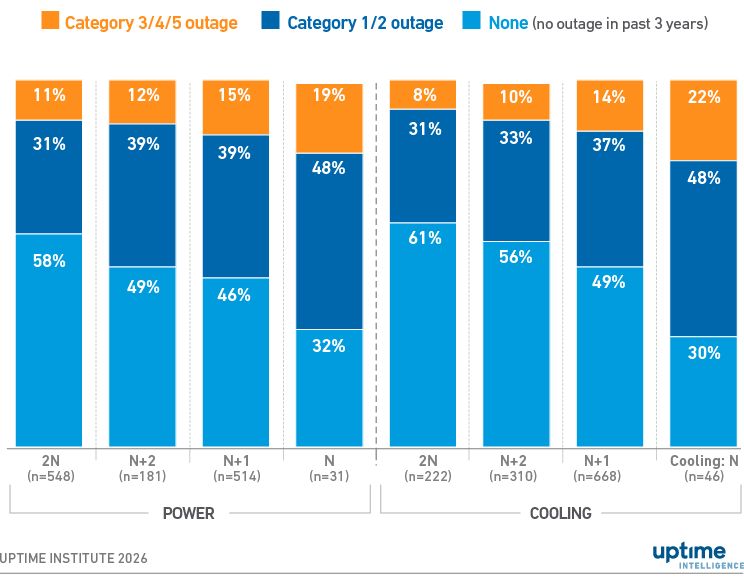
Figure 1 shows the number of respondents who reported at least one outage in the past 3 years, segmented by the reported cooling and power redundancy configuration.
Figure 1 Outage incidents segmented by redundancy configuration
The results show a strong and consistent relationship between infrastructure redundancy and outage incidence. For cooling, the proportion of respondents reporting an outage increased from 39% among those using 2N configurations to 70% among those using N. Power followed a similar pattern, rising from 42% for 2N to 68% for N. Respondents using N+1 and N+2 configurations were less likely to experience outages than those using N, and more likely than those with 2N architectures.
Reduced redundancy was also associated with a higher number of serious incidents. Category 3–5 outages accounted for around 8-11% of respondents with 2N configurations, and approximately 19-22% of those using N. The results suggest that greater redundancy is associated not only with fewer outages overall, but also with a substantially lower likelihood of experiencing a serious outage.
The pattern is clear across both power and cooling. However, the results for N configurations should be interpreted cautiously because they are based on relatively small samples. Nevertheless, even if those are excluded, the pattern remains when examining N+1 and N+2 configurations against 2N.
Quantifying gains
Correlation is not causation. The consistency of the association across power and cooling supports the expected value of redundancy. However, the analysis cannot isolate redundancy from other characteristics associated with resilient facilities, including operational maturity, maintenance practices, equipment condition and overall system design. The outages reported were not necessarily directly caused by power or cooling (although these together account for more than two-thirds of reported impactful outages in the 2026 Uptime Institute annual data center survey).
And yet, these figures are reasonable indicators of the probability of a data center experiencing at least one outage over 3 years, segmented by power and cooling redundancy. As a result, an indicator of the reduction in likelihood of a financially impactful outage (categories 3, 4 and 5) due to an increase in redundancy can be calculated (see Figure 2).
Figure 2 Reduction in likelihood of at least one outage due to redundancy upgrades
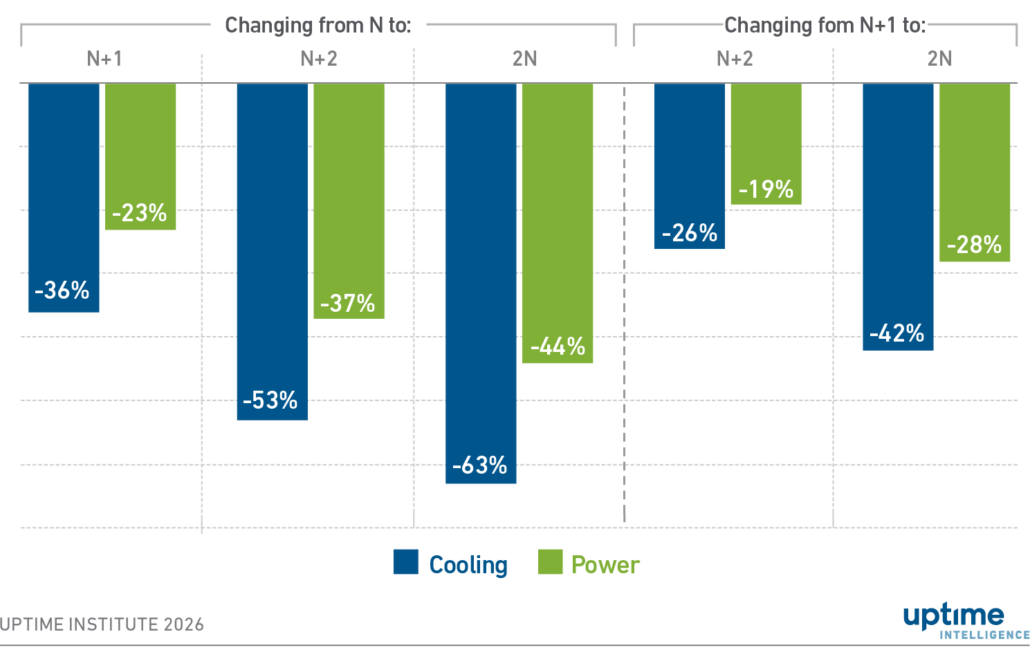
Redundancy does not eliminate outages, but it is associated with a material reduction in the likelihood of experiencing a serious outage. Moving from N to N+1 is associated with a meaningful improvement, while N+2 and 2N provide progressively greater reductions.
Compared with respondents using N configurations, the likelihood of reporting at least one financially impactful outage in 3 years was approximately 36% lower for N+1 cooling, 53% lower for N+2 and 63% lower for 2N. The corresponding reductions for power were approximately 23%, 37% and 44%.
Few data centers operate without any power or cooling redundancy in an N configuration. A more reasonable baseline is an N+1 configuration. In this case, 2N cooling is 42% less likely to have an outage and N+2 is 26% less likely.
These results are best used as indicative reference points rather than predictions for an individual facility. They do not establish the precise return on an upgrade, because outage risk also depends on factors such as equipment condition, maintenance, operational practices and system design. Nevertheless, they provide a rough order of magnitude for a benefit that is generally understood but rarely quantified: greater infrastructure redundancy is associated with substantially lower outage exposure.
The Uptime Intelligence View
Greater power and cooling redundancy are associated with a substantial reduction in both impactful and financially damaging outages. Although the results cannot predict the benefit for an individual facility, they provide an indicative benchmark that operators can use when weighing the cost of additional infrastructure against their exposure to downtime.
Dr. Owen Rogers, Senior Research Director for Cloud Computing, orogers@uptimeinstitute.com
Douglas Donnellan, Senior Research Associate, ddonnellan@uptimeinstitute.com
The following Uptime Institute expert was consulted for this report:
Chris Brown, CTO, Uptime Institute
The post Survey findings link higher redundancy to lower outage risk appeared first on Website Host Review.